SECTION 3.2 – INDOOR STORAGE
SECTION 3.2 INDOOR STORAGE
Subsection 3.2.1. Indoor Tire Storage
Application
3.2.1.1. This Subsection applies to buildings used for the storage of tires in which the bulk volume of tires stored in one fire compartment exceeds 425 m3.
Tire pile dimensions
3.2.1.2. A single pile of tires in a tire storage location shall occupy an area not greater than 500 m2 with a maximum length of 30 m.
3.2.1.3. (1) The maximum piling height of tires shall not exceed the height used for the design of the sprinkler system installed as required in Article 3.2.1.8.
(2) The maximum piling height allowed in Sentence (1) shall be posted in conspicuous locations.
Pile clearance
3.2.1.4. A clearance of at least 914 mm shall be maintained between the tops of piles and sprinkler head deflectors.
3.2.1.5. Aisles between individual piles shall be at least 1.8 m wide.
3.2.1.6. A clearance of at least 600 mm shall be maintained between piles of tires and columns and enclosing walls.
3.2.1.7. A tire storage location shall be classified as a medium-hazard industrial occupancy.
Warehouse sprinkler systems
3.2.1.8. (1) If the floor area of a tire storage location exceeds 250 m2, the floor area shall be provided with a sprinkler system installed in accordance with NFPA 13, “Standard for the Installation of Sprinkler Systems”.
(2) The design of the sprinkler system required in Sentence (1) shall be based on the maximum piling height available.
3.2.1.9. A standpipe and hose system shall be installed in conformance with NFPA 13, “Standard for the Installation of Sprinkler Systems”.
Portable extinguishers
3.2.1.10. (1) In addition to the requirements of Section 6.2, multi-purpose dry chemical portable extinguishers having a rating of 4A:80B shall be installed
(a) in every 500 m2 of floor area, and
(b) so that the distance travelled to any extinguisher does not exceed 25 m.
Subsection 3.2.2. Indoor General Storage
Application
3.2.2.1. (1) Subject to Sentences (2) and (3), this Subsection applies to the indoor general storage of combustible solids, noncombustible solids with combustible packaging or storage aids, including storage in bin boxes, shelves or racks.
(2) This Subsection, except Article 3.2.2.6., does not apply to special hazard commodities covered elsewhere in this Code.
(3) This Subsection does not apply to the bulk storage of unpackaged grain, coal or similar commodities.
Storage dimensions
3.2.2.2. (1) An individual storage area shall not exceed 500 m2 in buildings that are not sprinklered.
(2) An individual storage area shall not exceed 1000 m2 in sprinklered buildings.
(3) Heights of storage in buildings that are not sprinklered shall not exceed 4.5 m.
(4) The maximum height of storage of any individual storage area shall be determined according to
(a) the stability of the stored products as it relates to the base area and shape, and
(b) the height limitations otherwise set in this Subsection.
(5) Buildings containing individual storage areas that exceed 6.4 m in height shall be protected with
(a) a sprinkler system designed and installed in accordance with NFPA 13, “Standard for the Installation of Sprinkler Systems”, or
(b) a sprinkler system installed before January 1, 2015 that has been approved.
Pile clearance
3.2.2.3. (1) The clearance between sprinkler head deflectors and the top of any storage shall not be less than 457 mm.
(2) Where the top of any storage is above the lower chords of floor or roof structural framing members, a horizontal clear space of at least 300 mm shall be maintained between the storage and the structural members.
Fire access aisles
3.2.2.4. At least one main aisle having a width equal to at least half the height of the highest adjacent pile and extending the length of the structure shall be provided but in no case shall the width of the aisle be less than 2.4 m.
3.2.2.5. Aisles separating individual storage areas described in Article 3.2.2.2. shall be at least 2.4 m wide.
3.2.2.6. (1) Adequate access for fire fighting purposes shall be provided and maintained to all portions of the premises, in conformance with Sentences (2) to (6).
(2) Access aisles not less than 1.0 m wide shall be provided to exits, to fire department access panels and to fire protection equipment.
(3) Aisles shall be maintained free of obstruction.
(4) Except as permitted by Sentence (5), at least one main access aisle shall extend the length of the building with a minimum width of
(a) 2.4 m for storage heights not more than 6 m, and
(b) 3.6 m for storage heights of more than 6 m.
(5) Narrower aisles may be approved where the building is sprinklered and the sprinkler design is based on aisle widths less than required by Sentence (4) but in no case shall the aisle width be less than the aisle width on which the sprinkler design is based.
(6) In storage areas that exceed 200 m2, main access aisles referred to in Sentence (4) shall be accessible from at least two fire department access points, which shall be located such that, in the event one becomes unusable due to fire, the other will still allow emergency responders to access the building.
3.2.2.7. Wall clearances of at least 600 mm shall be maintained where stored commodities may swell or expand with the absorption of water.
Palletized storage arrangements
3.2.2.8. Palletized storage shall be arranged so that unobstructed horizontal channels formed by the top and bottom of pallets shall not exceed 15 m.
3.2.2.9. Except as permitted in Article 3.2.2.10., pallets and dunnage not in use shall be stored outdoors and be located so as to avoid an exposure hazard.
Pallet storage
3.2.2.10. (1) Except as permitted in Sentences (2) and (3), combustible pallets shall be stored outdoors in conformance with Section 2.4.
(2) Indoor storage of combustible pallets is permitted in a building that is not sprinklered, provided
(a) the height of storage of combustible pallets is not more than 1.2 m,
(b) the width of an individual storage area is not more than 7.5 m, and
(c) the aggregate area of storage is not more than
(i) 100 m2 for wood or solid deck non-expanded polyethylene pallets, or
(ii) 50 m2 for plastic pallets not described in Subclause (i).
(3) In a sprinklered building, the storage of combustible pallets is permitted to exceed the values in Sentence (2) provided such storage conforms to NFPA 13, “Standard for the Installation of Sprinkler Systems”.
Smoking prohibited
3.2.2.11. Smoking shall not take place in indoor storage areas, except as provided in Subsection 2.4.3.
Subsection 3.2.3. Indoor Storage of Ammonium Nitrate
Application
3.2.3.1. (1) This Subsection applies to the storage of ammonium nitrate mixtures that are
(a) classified as Class 5.1 Oxidizing Substances under Part 2 of the Transportation of Dangerous Goods Regulations, SOR/2001-286, made under the Transportation of Dangerous Goods Act (Canada), and
(b) stored in quantities exceeding 1000 kg inside buildings.
(2) This Subsection does not apply to
(a) blasting agents, or
(b) ammonium nitrate and ammonium nitrate mixture storage on railways regulated by the Canadian Transport Commission.
Storage buildings
3.2.3.2. (1) A building used for the storage of ammonium nitrate shall not be more than 1 storey in building height.
(2) A building used for the storage of ammonium nitrate shall not
(a) have basements or crawl spaces, or
(b) contain open floor drains, tunnels, elevator pits or other pockets which might trap molten ammonium nitrate.
(3) A building used for the storage of ammonium nitrate shall have not less than 70 cm2 in vent area for each square metre of storage area unless mechanical ventilation is provided.
(4) All flooring in storage areas shall be of noncombustible materials.
(5) A building used for the bulk storage of ammonium nitrate shall be designed to prevent contact with building material that
(a) will cause the ammonium nitrate to become unstable,
(b) may corrode or deteriorate by reason of contact with the ammonium nitrate, or
(c) will become impregnated by ammonium nitrate.
(6) The distance between an ammonium nitrate storage facility and the property line of another property shall be not less than
(a) 15 m where the other property contains a warehouse for flammable liquids storage or a facility for loading or unloading flammable liquids,
(b) 15 m where the other property contains a building classified as medium-hazard industrial occupancy or low-hazard industrial occupancy provided the ammonium nitrate storage facility does not exceed 200 t of ammonium nitrate,
(c) 30 m where the other property contains a building classified as industrial occupancy not covered in Clause (b), flammable liquids storage tanks, flammable gas storage tanks or other tanks containing a hazardous substance, or
(d) 90 m for all other occupancies.
(7) The distance in Clause (6)(b) may be reduced to 7.5 m if a firewall that has a fire-resistance rating not less than 2 h is provided between the storage facility and the building it exposes.
(8) The distance in Clause (6)(c) may be reduced to 15 m for a medium-hazard industrial occupancy or a low-hazard industrial occupancy if a firewall that has a fire-resistance rating not less than 2 h is provided between the storage facility and the building it exposes.
(9) The use of buildings or structures that do not conform with the provisions of Sentences (6) to (8) may be approved where the buildings or structures do not constitute a hazard to life or property from fire or explosion.
(10) Except where other forms of exposure protection are approved, the walls of the exposed side of a storage building shall be noncombustible where such walls are within 15 m of a
(a) combustible building,
(b) forest, or
(c) pile of combustible material.
Industrial trucks
3.2.3.3. (1) In addition to the requirements of Section 3.4, industrial trucks used or stored within the building shall be maintained so that fuels or hydraulic fluids do not contaminate the ammonium nitrate.
(2) Fuel-dispensing operations shall not be carried out in buildings where ammonium nitrate is stored.
(3) An internal combustion engine shall be continuously monitored at all times in a building where ammonium nitrate is stored unless the engine is located in an area that will prevent the spread of a fire originating in the engine.
(4) Industrial trucks used for the transportation of ammonium nitrate shall be cleaned of remaining material following use.
Portable extinguishers
3.2.3.4. In addition to the requirements of Section 6.2, pressurized-water portable extinguishers having a rating of 2A or larger shall be installed.
Storage
3.2.3.5. (1) Individual storage areas of bagged ammonium nitrate shall not exceed 1500 m2 in area and 9 m in height.
(2) Wall clearances of not less than 600 mm shall be maintained where stored products may swell or expand with the absorption of water.
(3) In buildings that are not sprinklered, a clearance of not less than 1 m between the top of storage and the underside of the floor or roof deck shall be maintained.
(4) The clearance between the top of storage and ceiling sprinkler deflectors shall conform to the standard used to design the sprinkler system.
(5) Ammonium nitrate shall not be stored in an area where the ambient temperature is such that it can become unstable or susceptible to undesirable reactions.
(6) Ammonium nitrate storage shall be identified by signs of contrasting colours indicating the contents with letters 50 mm high.
(7) Bulk storage of ammonium nitrate shall be located indoors or in enclosed bin-type structures.
(8) Bins used for the storage of ammonium nitrate shall not contain galvanized iron, copper, lead or zinc or other materials that may contaminate or be corroded by ammonium nitrate.
Automatic sprinklers
3.2.3.6. (1) Ammonium nitrate shall be stored only in buildings equipped with an automatic sprinkler system installed in conformance with NFPA 13, “Standard for the Installation of Sprinkler Systems”.
(2) Sentence (1) does not apply where the existing situation is approved and does not endanger life safety or alternative measures to the requirements set out in Sentence (1) are taken to provide life safety.
Disposal
3.2.3.7. (1) Spilled ammonium nitrate material shall be disposed of in conformance with Sentences (2) to (5).
(2) Uncontaminated material may be rebagged in suitable slip-over bags and sealed to prevent spillage.
(3) Unsalvageable material shall be removed by sweeping and burial.
(4) After flushing and scrubbing contaminated areas very thoroughly to dissolve all material, the residue shall be washed away with hoses.
(5) Empty bags shall be disposed of by burning outdoors where permitted in a safe area, or by burial.
Explosives prohibited
3.2.3.8. Explosives shall not be used to break up caked ammonium nitrate.
Smoking and open flames prohibited
3.2.3.9. (1) Smoking shall not take place and open flames shall not be used in buildings used for the storage of ammonium nitrate.
(2) Signs with letters 50 mm high indicating that ammonium nitrate is being stored and that smoking is not permitted shall be prominently displayed near each entrance on the exterior of buildings identified in Sentence (1).
Heating equipment
3.2.3.10. Heating equipment shall be separated from any storage area in conformance with the requirements of the Building Code.
Subsection 3.2.4. Indoor Storage of Combustible Fibres
Application
3.2.4.1. This Subsection applies to the indoor storage of combustible fibres.
Building size for storage and handling of combustible fibres
3.2.4.2. Buildings used for the storage and handling of combustible fibres shall comply with the height and area limitations of the Building Code for medium-hazard industrial occupancies.
Loose fibre storage
3.2.4.3. (1) Up to 3 m3 of loose combustible fibres may be stored in a single fire compartment if they are kept in metal-lined bins equipped with self-closing metal-lined covers.
(2) Quantities of loose combustible fibres exceeding 3 m3 but not exceeding 15 m3 shall be stored in rooms separated from the remainder of the building by a fire separation that has a fire-resistance rating not less than 1 h.
(3) Quantities of loose combustible fibres exceeding 15 m3 but not exceeding 30 m3 shall be stored in rooms separated from the remainder of the building by a fire separation that has a fire-resistance rating not less than 2 h.
(4) Quantities of loose combustible fibres that exceed 30 m3 shall be stored in an individual room
(a) that is sprinklered in accordance with NFPA 13, “Standard for the Installation of Sprinkler Systems”, and
(b) that is separated from the remainder of the building by a fire separation having a fire-resistance rating not less than 2 h.
(5) Quantities of loose combustible fibres stored in an individual room referred to in Sentence (4) shall be arranged so that an individual pile does not exceed 250 m2 in area and is separated from other piles by aisles that are at least 2.4 m wide.
(6) Clause (4)(a) does not apply to a sprinkler system that met the requirements of this Code on December 31, 2014, as it read on that day.
Baled fibre storage
3.2.4.4. (1) Baled combustible fibres shall be stored so that
(a) a single pile will not contain more than 700 m3,
(b) the maximum height of any single pile will not exceed 4.5 m,
(c) piles are separated by aisles not less than 1.5 m wide, and
(d) the clearance between piles and building walls is not less than 1 m.
Baled storage piles
3.2.4.5. The sides of baled storage piles shall be inclined back from the base of the pile with a slope of not less than 1 m for each 10 m of height.
Clearance for sprinklers and structural framing
3.2.4.6. (1) The clearance between sprinkler head deflectors and the tops of storage piles shall not be less than 457 mm.
(2) If the storage piles are above the lower chords of floor or roof structural framing members, a horizontal clear space of 300 mm shall be maintained between the storage and the structural members.
Heating equipment
3.2.4.7. (1) Unless controlled in a manner that will not create a fire or explosion hazard, fuel-fired appliances and electrical heating elements shall not be used in a storage area for combustible fibres.
(2) Shields shall be provided that will prevent stored material from coming within 300 mm of any part of a heating system heat distribution network.
Standpipe and hose system installations
3.2.4.8. Standpipe and hose systems shall be installed in accordance with the Building Code.
Portable extinguishers
3.2.4.9. Portable extinguishers shall be provided in accordance with Section 6.2.
Smoke vents
3.2.4.10. If combustible fibres are stored in a building, automatic smoke venting hatches that are manually operable from remote locations and have a combined opening area of 64 cm2 for each square metre of floor area shall be provided.
Subsection 3.2.5. Indoor Storage of Aerosol Products
Application
3.2.5.1. This Subsection shall apply to the indoor storage of packaged aerosol products as classified in Article 3.2.5.2.
Classification
3.2.5.2. For the purposes of this Subsection, aerosol products shall be classified as Level 1, 2 or 3 in conformance with NFPA 30B, “Code for the Manufacture and Storage of Aerosol Products”.
Level 1 aerosols
3.2.5.3. Packaged Level 1 aerosol products shall be protected as required for Class III commodities, in both palletized and rack storage, in conformance with Article 3.2.7.19.
Level 2 and 3 aerosols
3.2.5.4. (1) The storage of packaged Level 2 and 3 aerosol products shall conform to Table 3.2.5.4. and Articles 3.2.5.5. to 3.2.5.8.
(2) Where storage of packaged aerosol products is mixed, protection shall be provided for the most hazardous classification present.
Table 3.2.5.4.
Maximum Amount of Packaged Level 2 and 3 Aerosol Products, kg(1)
Forming Part of Article 3.2.5.4.
| Amount of Packaged Level 2 and 3 Aerosol Products | Less than or equal to 1000 kg in building that is not sprinklered | Greater than 1000 kg but less than or equal to 5000 kg in building that is not sprinklered | Greater than 5000 kg but less than or equal to 10000 kg in building that is not sprinklered | Less than or equal to 10000 kg in sprinklered building | Greater than 10000 kg but less than or equal to 50000 kg in sprinklered building | Greater than 50000 kg in sprinklered building |
| Type of Dedicated Area required | None | Type A(2) | Type B(3) | None | Type A(2) | Type B(3) |
Notes to Table 3.2.5.4.:
(1) One pallet load of packaged aerosols is approximately 1000 kg.
(2) See Article 3.2.5.6.
(3) See Article 3.2.5.7.
Sprinkler systems
3.2.5.5. (1) A sprinkler system that is used for the storage of Level 2 and 3 aerosol products shall be designed and installed in conformance with NFPA 13, “Standard for the Installation of Sprinkler Systems”, with additional sprinkler protection provided in conformance with NFPA 30B, “Code for the Manufacture and Storage of Aerosol Products” for areas in which packaged aerosol products are stored.
(2) If a sprinkler system that is used for the storage of Level 2 and 3 aerosol products does not conform to Sentence (1), the building shall be deemed to not be sprinklered for the purpose of applying Table 3.2.5.4.
Type A dedicated areas
3.2.5.6. (1) Where a Type A dedicated storage area is required to accommodate the storage limits stated in Sentence 3.2.5.4.(1), it shall be separated from the remainder of the building by chain link fencing or a noncombustible partition that is capable of withstanding the impact of rocketing cans and that extends to the underside of the roof deck or to the ceiling which must also be capable of withstanding the impact of rocketing cans.
(2) Chain link fencing referred to in Sentence (1) shall be not lighter than 2.9 mm steel wire woven into a 50 mm diamond mesh.
Type B dedicated areas
3.2.5.7. (1) Where a Type B dedicated storage area is required to accommodate the storage limits in Sentence 3.2.5.4.(1), it shall be separated from the remainder of the building by partitions
(a) having not less than a 1 h fire-resistance rating,
(b) capable of withstanding the impact of rocketing cans, and
(c) extending to the underside of the roof or to a ceiling of construction equivalent to the partitions.
Storage height
3.2.5.8. (1) Except as provided in Sentence (2), the height of storage of packaged Level 2 or 3 aerosols shall be not greater than
(a) 1.75 m where products are in solid piles or on pallets, or
(b) 6.1 m where products are on racks.
(2) Where the building is sprinklered in conformance with Article 3.2.5.5. and an enclosure conforming to Article 3.2.5.6. or 3.2.5.7. is provided, the height of storage of packaged Level 2 or 3 aerosols shall be not greater than
(a) 6.1 m where products are in solid piles or on pallets, or
(b) the height limit determined by the design capacity of the sprinkler system where products are on racks.
Aisles
3.2.5.9. Aisles separating racks, shelves or piles of packaged Level 2 or 3 aerosol products shall be not less than 2.4 m wide.
Subsection 3.2.6. RESERVED
Subsection 3.2.7. Indoor Storage of Dangerous Goods
Application
3.2.7.1. (1) Except as otherwise specified in this Code, this Subsection applies to buildings or parts of buildings where dangerous goods in packages or containers are stored in a single fire compartment.
(2) Where the amount of stored dangerous goods referred to in Sentence (1) does not exceed the amount stated in Column C of Table 3.2.7.1., it shall be exempted from the requirements of this Subsection.
(3) Where a product has multiple classes, the applicable small quantity exemption referred to in Sentence (2) shall be determined using
(a) Column A of Table 3.2.7.1. based on the class having precedence, as established in Section 2.8 of Transportation of Dangerous Goods Regulations, SOR/2001-286, made under the Transportation of Dangerous Goods Act (Canada),
(b) Column B of Table 3.2.7.1. based on the class having precedence, for hazardous products under the “Workplace Hazardous Materials Information System (WHMIS)” for hazardous products determined in Part 7 of the Hazardous Products Regulations, SOR/2015-17, made under the Hazardous Products Act (Canada), or
(c) when the class having precedence cannot be established, Column C of Table 3.2.7.1. based on the lesser of the two small quantity exemptions.
Table 3.2.7.1.
Small Quantity Exemptions for Dangerous Goods
Forming Part of Article 3.2.7.1.
| OFC Class | Column A TDG Class(1) and description | Column B WHMIS Class(2) | Column C Maximum Exempt Amount of Stored Product |
| Explosives | 1 – Explosives | N/A | See Article 3.1.1.3. |
| Compressed gases | 2 – Gases | A | N/A |
| Compressed gases – Flammable gases/aerosols | 2 – Division 1, flammable gases | B1 | 25 kg |
| Compressed gases – Flammable gases/aerosols | 2 – Division 1, flammable gases | B5 | See Subsection 3.2.5 |
| Compressed gases Non-flammable, non-toxic gases – | 2 – Division 2, non-flammable, non-toxic gases | A | 150 kg |
| Compressed gases – Oxidizing gases | 2 – Division 2, non- flammable, non-toxic gases with subsidiary Class 5.1 | A+C | 75 kg |
| Toxic gases | 3 – Division 3 toxic gases | A+D1, A+D2 or A+E | 0 |
| Flammable liquids | 3 – Flammable Liquids | B2 or B3 | See Part 4 |
| Flammable solids | 4 – Division 1 flammable solids | B4 | 100 kg(6) |
| Pyrophoric materials | 4 – Division 2 substances liable to spontaneous combustion | N/A | 50 kg |
| Water-reactive substances | 4 – Division 3 water-reactive substances | B6 | 50 kg |
| Oxidizing substances(7) | 5 – Oxidizing substances and organic peroxides | N/A | N/A |
| Oxidizing substances(7) – Oxidizers | 5 – Division 1 oxidizing substances(8) Packing Group I, II or III | N/A | 250 kg or 250 L |
| Oxidizing substances(7) – Organic peroxides | 5 – Division 2 organic peroxides | C(9) | 100 kg or 100 L |
| Toxic and infectious substances | 6 – Toxic and infectious substances | D | N/A |
| Toxic and infectious substances – Toxic substances | 6 – Division 1 toxic substances, Packing Group I | D1A | 0 |
| Toxic and infectious substances – Toxic substances | 6 – Division 1 toxic substances, Packing Group II | D1B | 100 kg or 100 L |
| Toxic and infectious substances – Toxic substances | 6 – Division 1 toxic substances, Packing Group III | D2A or D2B | 1000 kg or 1000 L |
| Toxic and infectious substances – Infectious materials | 6 – Division 2 infectious substances | D3 | 0 |
| Radioactive materials | 7 – Radioactive materials | N/A | See Article 3.1.1.2. |
| Corrosives | 8 – Corrosives(8) | N/A | N/A |
| Corrosives | 8 – Corrosives(8), Packing Group I | E | 500 kg or 500 L |
| Corrosives | 8 – Corrosives(8), Packing Group II | E | 1000 kg or 1000 L |
| Corrosives | 8 – Corrosives(8), Packing Group III | E | 2000 kg or 2000 L |
| Miscellaneous dangerous goods | 9 – Miscellaneous products, substances or organisms | N/A | See Article 3.1.2.1.(10) |
| Dangerously Reactive Materials | N/A | F | 0 |
Notes to Table 3.2.7.1.:
(1) The numbers refer to the class and division of dangerous goods as defined in the Transportation of Dangerous Goods Regulations, SOR/2001-286 (TDGR), made under the Transportation of Dangerous Goods Act (Canada).
(2) The categories and subcategories in the “Workplace Hazardous Materials Information System (WHMIS)” refer to hazardous products classified in Part 7 of the Hazardous Products Regulations, SOR/2015-17, made under the Hazardous Products Act (Canada).
(3) RESERVED.
(4) RESERVED.
(5) RESERVED.
(6) 50 kg for nitrocellulose-based products; 10 kg for “strike anywhere” matches.
(7) “Oxidizing substances” refers to solids or liquids, not gases.
(8) The TDGR defines “packing group” as “a group in which dangerous goods are included based on the inherent danger of the dangerous goods.” Packing Group I products are more hazardous than Packing Group III products.
(9) Class C in the WHMIS applies to oxidizing materials. Oxidizers do not usually self-combust but they will feed a fire by supplying oxygen or cause other materials to suddenly ignite. Oxidizers exist in all three states: gas (oxygen, ozone), liquid (nitric acid, perchloric acid solutions) and solid (potassium permanganate, sodium chlorite). Some oxidizers, such as the organic peroxide family, have both combustibility and oxidizing properties, which means they can have strong reactions that can result in an explosion.
The exempt amount listed for oxidizing materials in this Table applies to two categories of oxidizers based on the TDGR classification: oxidizing substances and organic peroxides. Since the WHMIS does not have a corresponding classification for these two categories of oxidizers, it was decided that the exempt amount applicable to Class C should be the more stringent one, thus reducing the potential that large quantities of oxidizing materials with combustibility properties will be stored without implementing the applicable safety measures in Subsection 3.2.7.
(10) Small quantity exemptions may be determined by other authorities such as the TDGR, the WHMIS and environmental protection legislation.
Ignition sources
3.2.7.2. (1) Heating appliances shall not be permitted in a fire compartment used for the storage of dangerous goods classified as flammable gases, flammable liquids, flammable solids, pyrophoric materials, water-reactive substances, oxidizers or organic peroxides, unless they are installed in a manner that will not create a fire or explosion hazard.
(2) Smoking shall not be permitted within a fire compartment used for the storage of dangerous goods and signs shall be posted in conformance with Article 2.4.3.2.
(3) Except as provided in Sections 3.4. and 5.17, open flames and spark-producing devices shall not be used in an area where dangerous goods are stored.
Ambient conditions
3.2.7.3. (1) Rooms or parts of buildings used for the storage of dangerous goods
(a) shall be dry and cool, and
(b) where the products being stored are capable of releasing flammable or toxic gases or vapours under normal ambient conditions, shall be provided with a ventilation system to exhaust such gases or vapours outdoors to an area where they will not return to the building.
Housekeeping
3.2.7.4. (1) Areas where dangerous goods are stored shall be kept free of waste packaging materials, debris of any kind or any spilled product.
(2) Broken packages or containers of dangerous goods shall be moved to a safe location and the product repackaged and labelled as soon as possible.
Storage arrangements
3.2.7.5. (1) The method of storage of dangerous goods shall
(a) be determined to ensure the physical and chemical stability of the stored products,
(b) except as provided in Sentences (2) and (5), not exceed the maximum heights of storage shown in Table 3.2.7.5., and
(c) not exceed the maximum base areas for individual storage areas shown in Table 3.2.7.19.
(2) Storage heights for a protected storage area stated in Table 3.2.7.5. are permitted to be exceeded provided the dangerous goods are stored on racks or shelves.
(3) When a storage area is required by this Article to be protected, it shall be sprinklered or protected with a special fire suppression system, in conformance with NFPA 13, “Standard for the Installation of Sprinkler Systems”, Part 2 and good engineering practice with respect to specific dangerous goods.
(4) Stored dangerous goods other than compressed gases shall be kept not less than 100 mm above the floor level.
(5) Flammable liquids and combustible liquids shall be stored in conformance with Part 4.
(6) Except as permitted in Table 3.2.7.6. of this Code, solid and liquid dangerous goods classified as oxidizers or organic peroxides shall be separated from the remainder of the building in conformance with Sentence 3.3.6.2.(1) of Division B of the Building Code, as it read on January 1, 2025.
(7) Reactive materials shall be separated from the remainder of the building in conformance with Sentence 3.3.6.2.(2) of Division B of the Building Code, as it read on January 1, 2025.
(8) Packages or containers of dangerous goods classified as organic peroxides shall not be opened, or the product dispensed, in the same area where it is stored.
(9) Except where the width of storage of dangerous goods is not more than 1.5 m, measured out from the wall, wall clearances of not less than 400 mm shall be maintained.
Table 3.2.7.5.
Storage Height Limits for Dangerous Goods, m
Forming Part of Article 3.2.7.5.
| Packing Group(1) | Storage Height Limits for Dangerous Goods in Unprotected Storage (m) | Storage Height Limits for Dangerous Goods in Protected Storage (m) |
| Packing Group I | 1.8 | 2.4 |
| Packing Group II | 2.4 | 4 |
| Packing Group III | 4.5 | 6 |
Notes to Table 3.2.7.5.:
(1) See Table 3.2.7.1.
Separation from other dangerous goods
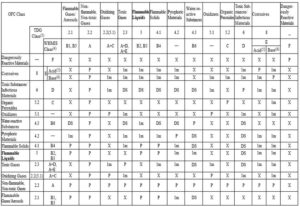
3.2.7.6. (1) Except as required in Sentences (3) and (4), Clause 5.6.2.4.(1)(h) and Article 5.6.2.6., dangerous goods shall be separated from other dangerous goods in conformance with Table 3.2.7.6.
(2) The fire-resistance rating of the fire separations delimiting each fire compartment shall be determined in accordance with the applicable requirements of the Code.
(3) In addition to the separation requirements in Sentence (1), dangerous goods shall be stored in conformance with the information provided in the Safety Data Sheet for the specific dangerous good.
(4) Flammable liquids, combustible liquids and dangerous goods classified as corrosives shall not be stored with dangerous goods classified as radioactive materials in quantities or in a manner that would constitute an undue risk in the event of a fire.
Table 3.2.7.6.
Separation Chart for Storage of Dangerous Goods(1)(2)
Forming Part of Article 3.2.7.6.
Notes to Table 3.2.7.6.:
(1) For the purpose of this Table:
- If a dangerous good has both a TDG Class and a WHMIS Class, the TDG Class shall apply.
- If two dangerous goods each have a TDG Class with or without a WHMIS Class, the TDG Class shall apply.
- If two dangerous goods each have a WHMIS Class but no TDG Class, the WHMIS Class shall apply.
- If one dangerous good has a WHMIS Class but no TDG Class and another dangerous good has a TDG Class but no WHMIS Class, the TDG Class and the WHMIS Class in combination shall apply.
(2) Definitions for entries in this Table:
X = incompatible dangerous goods: these goods shall be stored in separate fire compartments.
1m = incompatible dangerous goods: these goods shall be separated by a horizontal distance of not less than 1 m.
P = permitted dangerous goods: these goods are permitted to be stored close together.
DS = refer to Safety Data Sheet for these dangerous goods.
A+C = hazardous products of Class A combined with C.
A+D = hazardous products of Class A combined with D.
A+E = hazardous products of Class A combined with E.
B2, B3 = hazardous products of Class B2 or B3.
B1, B5 = hazardous products of Class B1 or B5.
(3) The numbers refer to the classes and divisions of dangerous goods as defined in the Transportation of Dangerous Goods Regulations, SOR/2001-286, made under the Transportation of Dangerous Goods Act (Canada).
(4) The letters and numbers refer to the categories and subcategories of hazardous products under the “Workplace Hazardous Materials Information System (WHMIS)” as classified in Part 7 of the Hazardous Products Regulations, SOR/2015-17, made under the Hazardous Products Act (Canada).
(5) Acid: corrosive materials with a pH below 2 according to the Safety Data Sheet.
(6) Base: corrosive materials with a pH above 11.5 according to the Safety Data Sheet.
Corrosion protection
3.2.7.7. Measures shall be taken to prevent or minimize corrosion or deterioration of shelving, racks and piping system components due to contact with stored dangerous goods.
Flooring materials
3.2.7.8. (1) Floors in areas where dangerous goods are stored shall be
(a) constructed in conformance with Sentence 3.3.6.7.(1) of Division B of the Building Code, as it read on January 1, 2025, and
(b) maintained as an impervious membrane.
(2) Dangerous goods classified as oxidizers or organic peroxides shall not be stored on combustible floors or platforms.
Fire suppression systems
3.2.7.9. (1) Except as permitted in Sentences (2) and (3) and in Part 4, buildings used for the storage of dangerous goods regulated by this Subsection shall be equipped throughout with a
(a) sprinkler system designed in conformance with Article NFPA 13, “Standard for the Installation of Sprinkler Systems”, or
(b) fire suppression system designed in conformance with Article 2.1.3.5.
(2) Buildings described in Sentence (1) need not be equipped throughout with a sprinkler system or other fire suppression system provided that
(a) the sum of individual storage areas in the building used for the storage of dangerous goods, other than substances classified as miscellaneous dangerous goods with no other class and those covered in Part 4, does not exceed 100 m2, and
(b) the dangerous goods are
(i) separated in conformance with Table 3.2.7.6., and
(ii) stored in fire compartments separated from the remainder of the building by a fire separation having a fire-resistance rating of not less than 2 h.
(3) Buildings described in Sentence (1) need not be equipped throughout with a sprinkler system or other fire suppression system, provided that storage consists only of dangerous goods classified as non-flammable, non-toxic gases with no subsidiary class of oxidizing substances.
Smoke venting
3.2.7.10. Where the collective individual storage areas for dangerous goods exceed 10 m2 in a fire compartment, means shall be provided for manual or automatic venting of smoke and toxic gases from the storage area under fire conditions.
Spill control
3.2.7.11. (1) Measures to control spilled liquid or solid dangerous goods shall be provided in conformance with Subsection 4.1.6.
(2) Materials or liquids used in the cleanup of spills and leakages of dangerous goods shall be
(a) compatible and non-reactive with the dangerous goods being cleaned up, and
(b) disposed of in conformance with Subsection 4.1.6.
Fire department access
3.2.7.12. (1) Except as provided in Sentences (2) and (3), fire department access to buildings described in Article 3.2.7.1. shall be in conformance with Section 2.5.
(2) When the collective individual storage area for dangerous goods exceeds 10 m2, buildings regulated by Sentence (1) shall be accessible to fire department vehicles from at least two sides for the purpose of firefighting.
(3) In buildings regulated by Sentence (1), access openings to each storey provided in conformance with the Building Code shall be not less than 750 mm wide by 1100 mm high.
Labels
3.2.7.13. Products classified as dangerous goods shall display appropriate identifying labels from the time they enter a facility until they are issued as finished products or waste material.
Placards
3.2.7.14. (1) Individual storage areas used for the storage of dangerous goods and laboratories where dangerous goods are used shall be clearly designated as such by posted placards conforming to the Transportation of Dangerous Goods Regulations, SOR/2001-286, made under the Transportation of Dangerous Goods Act (Canada) and Sentences (2) to (4).
(2) Where the dangerous goods identified in Sentence (1) consist of a single product, only the UN number need be posted.
(3) Where the dangerous goods identified in Sentence (1) consist of multiple products within the same class, the individual class and division placard shall be posted.
(4) Where the dangerous goods identified in Sentence (1) consist of more than one class of products, a placard for each individual class, or the ”Danger” placard shown in the Transportation of Dangerous Goods Regulations, SOR/2001-286, made under the Transportation of Dangerous Goods Act (Canada), shall be posted at the entrance to the storage area.
(5) Individual storage areas described in Sentence (1) shall be identified in the fire safety plan as required in Article 2.8.2.6.
Training
3.2.7.15. (1) In a building regulated by this Subsection, at least one person shall
(a) be trained in conformance with Sentence (2),
(b) provide supervision during operating hours, and
(c) be available to respond to a day or night emergency.
(2) The person providing supervision specified in Sentence (1) shall be trained in the correct procedures for the handling, storing and offering for transport of dangerous goods.
(3) All persons involved in the storage and handling of dangerous goods shall be trained in safe handling procedures and correct responses to an emergency situation.
Unauthorized access
3.2.7.16. An area used for the storage of dangerous goods shall be secured against unauthorized access.
Separation from combustible products
3.2.7.17. Dangerous goods shall not be stored in the same individual storage area with other combustible products.
Storage of oxidizers in mercantile occupancies
3.2.7.18. (1) This Article applies to mercantile occupancies.
(2) Dangerous goods classified as oxidizers that are located within mercantile occupancies in quantities not exceeding those permitted by Table 3.2.7.1. shall be separated from ordinary combustible material by a distance of at least 1 m.
(3) A clear space of not less than 2.4 m shall be maintained between the oxidizing substances identified in Sentence (2) and any other dangerous goods.
Individual storage areas
3.2.7.19. (1) Except as provided in Sentence (2), the size of individual storage areas shall not exceed the limits shown in Table 3.2.7.19.
(2) In a sprinklered building, the height of storage in racks is permitted to exceed the limits shown in Table 3.2.7.19.
Table 3.2.7.19.
Size Limits for Individual Storage Areas
Forming Part of Article 3.2.7.19.
| Product Classification | Maximum area in building that is not sprinklered (m2) | Maximum height of storage in building that is not sprinklered (m) | Maximum area in sprinklered building (m2) | Maximum height of storage in sprinklered building (m) |
| Class I commodities | 500 | 6.5 | 1500 | 9.0 |
| Class II commodities | 500 | 6.5 | 1500 | 9.0 |
| Class III commodities, Group C plastics | 250 | 4.5 | 1000 | 9.0 |
| Closed containers of distilled beverage alcohol | 250 | 4.5 | 1000 | 9.0 |
| Class IV commodities, Group B plastics | 250 | 3.6 | 1000 | 9.0 |
| Group A plastics | 250 | 1.5 | 500 | 6.1 |
Sprinkler systems
3.2.7.20. Where a sprinkler system is required to accommodate individual storage areas referred to in Article 3.2.7.19., the sprinkler system shall be designed and installed in conformance with NFPA 13, “Standard for the Installation of Sprinkler Systems”.